
The Lady Vanishes
On the anniversary of Agatha Christie's disappearance

Today’s post is free of charge for all readers. If you enjoy it, please consider a free or paid subscription.
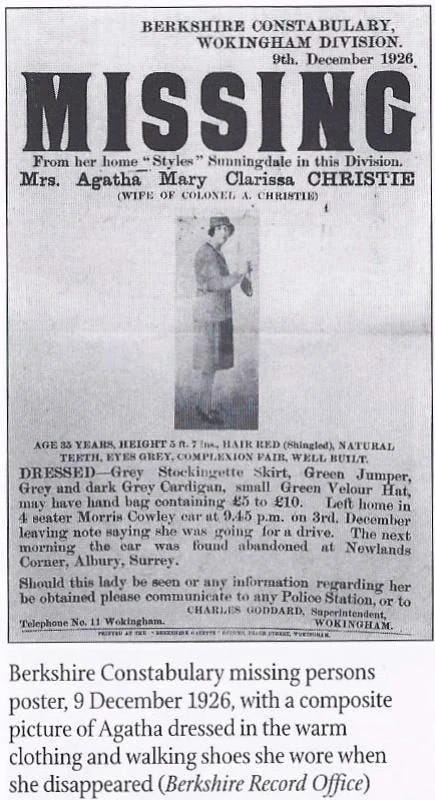
On December 3, 1926, the novelist Agatha Christie stormed out of her home in Sunningdale, Berkshire, and disappeared. In a case that seemed ripped from the pages of one of her own books, she turned up 11 days later at the Swan Hydropathic Hotel in Harrogate, staying under an assumed name and claiming to have no memory of why she was there.
Was she in a fugue state? Was it all a P.R. stunt? Was she running away from a doomed marriage?
Yes. Maybe. We don’t know.
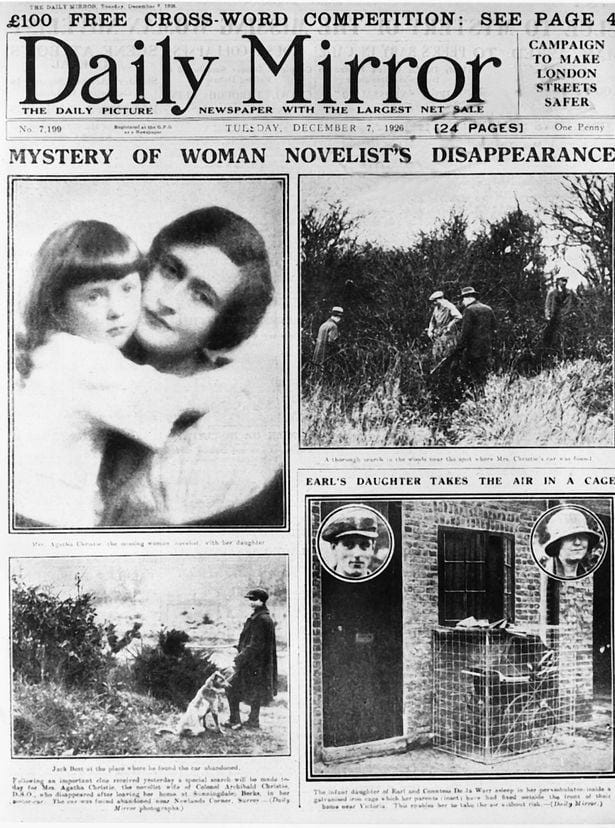
To this day, Christie’s disappearance has been the subject of intense speculation—both in fiction and nonfiction. It’s a case tailor-made for fans of her work, except there’s no Miss Marple or Hercule Poirot to step in during the penultimate chapter and explain what happened.
The facts (as we know them):
In August 1926, Archibald Christie told Agatha he wanted a divorce; he was in love with a woman named Nancy Neele.
To add to Christie’s emotional distress, earlier that year her mother had died, and Christie had been spending a great deal of time at her mother’s house sorting through her possessions.
On Friday, December 3, 1926, Agatha and Archie argued at their home, “Styles,”1 in Sunningdale, Berkshire, after Archie said he would spend the weekend away without her (and thus, presumably, with Neele). Agatha said goodnight to her daughter and left the house in her Morris Cowley — which, by the way, is a great name for a car company.
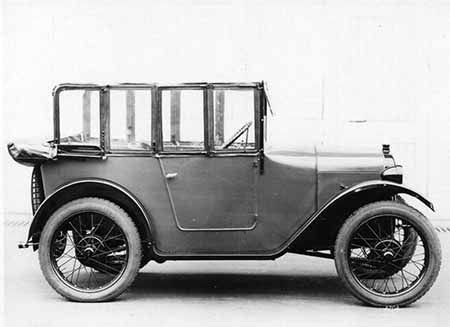
The Morris Cowley in question
On the morning of December 4, police found the car at Newlands Corner, near Guildford in Surrey, perched above a chalk pit. Had she crashed? Was it an attempted suicide? The author’s clothes and driver’s license were in the car, but there was no sign of Christie.
Police feared she might have drowned or taken her own life, and a massive search was launched; more than 1,000 police officers, around 15,000 volunteers, and several airplanes took part—an unprecedented effort for a missing private individual at the time.
Sherlock Holmes’s creator, Sir Arthur Conan Doyle, gave one of Christie’s gloves to medium Horace Leaf in an attempt to aid the search. Leaf said: “The person who owns it is half dazed and half purposeful. She is not dead as many think. She is alive. You will hear of her, I think, next Wednesday, in a location with connection to water.”
Having left her belongings in the car, Christie traveled to London, saw the Christmas display at Harrod’s, and then traveled toward to Harrogate, in Yorkshire, where she checked into Swan hotel under the assumed name Mrs. Tressa (or Teresa) Neele (Neele being the surname of her husband’s lover) from Cape Town, South Africa. Her assumption of this new persona was so total that, according to one biographer, she went so far as to put an ad in the paper that read: “Friends and relatives of Teresa Neele, late of South Africa, please communicate. Write Box R 702, The Times, EC4.”
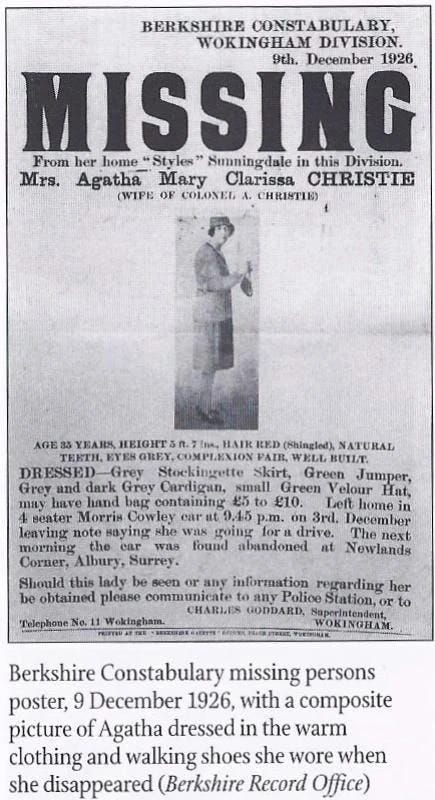
Sometime during her stay at the hotel (where she was seen dancing the Charleston and hobnobbing with other guests), members of the hotel’s house band recognized her from the photos in the press and reported her whereabouts to the police.
When Archie Christie showed up, Agatha claimed not to recognize him, and the doctors who examined her after the incident diagnosed an “unquestionable genuine loss of memory.”
To the delight of Arthur Conan Doyle, Horace Leaf turned out to be correct: while she’d been found on Tuesday, most people found out about it (“hear[d] of her”) on Wednesday; she was at a place near water (at the spa); and she did, indeed, appear to be “half dazed and half purposeful.”
This case has fascinated me since childhood. I think I first saw the Michael Apted film Agatha, a wild fictionalization of the case, in the early 1980s—right around the time I’d first read Death on the Nile and The Murder at the Vicarage. The idea that Christie’s own life might have been as exciting as her work was (and is) the sort of syncretic moment that I love in works of art.
However, modern scholarship has shown that the incident isn’t so much exciting as it is melancholic. Christie rarely spoke of the events, but in 1928—the year she divorced Archie—she did reveal that she’d planned to drive off the cliff where her car had been found. She said that as she drove toward her death, the vehicle “struck something with a jerk and pulled up suddenly. I was flung against the steering wheel and my head hit something.”2 That head injury would explain some of the amnesia she suffered, compounded by a dissociative state brought on by the one-two punch of her mother’s death and her husband’s infidelity.
I also can’t help but wonder if, during the days she was missing, the ability to become someone different—to try on an entirely new persona—felt liberating. As a writer myself, I understand the impetus—I just have a tendency to do it through my characters.
Agatha and Archie had named their home after the manor in The Mysterious Affair at Styles, her debut novel, which introduced Poirot and was her first success, though she only started to become a “famous” writer after the publication of The Murder of Roger Ackroyd, which came out about six months before her disappearance.
Read more about unraveling the mystery at https://www.thetimes.com/culture/books/article/what-really-happened-when-agatha-christie-went-missing-7qgw5strl